
 Before we talk about what you should do, it helps to understand what’s going on in your future patient’s mind.
They’re not searching “Traditional Chinese Medicine practitioner specializing in constitutional treatment.”
They’re typing things like:
- “acupuncturist near me”
- “acupuncture for back pain [city name]”
- “best acupuncturist in [neighborhood]”
- “does acupuncture help with anxiety”
Notice something? These searches are personal, local, and often condition-specific. The patient is in some degree of discomfort — physical or emotional — and they’re looking for help and reassurance at the same time.
Here’s the deeper truth: many of these people are a little skeptical. Acupuncture is still unfamiliar territory for a large portion of the population. Before they ever call your office, they are quietly vetting you. They’re looking at your star ratings, scanning your reviews, studying your photo, and reading a sentence or two about who you are.
They want to know: Is this person real? Do I trust them? Will this actually help me?
Your online presence is your answer to those questions — before you’ve ever spoken a word.
 When someone searches “acupuncturist near me,” the first thing they see isn’t a list of websites. They see a map — specifically, a cluster of three local listings called the Google Local Pack. This prime real estate at the top of the page is controlled almost entirely by your Google Business Profile (GBP), and it’s the single most important online asset a local practitioner can have.
If you haven’t claimed your Google Business Profile yet, that’s your first step. It’s free. Go to business.google.com, search for your practice, and claim it. Then fill it out completely and “completely” means everything:
- Accurate name, address, and phone number
- Your hours (including holiday hours)
- A list of your services
- A genuine, keyword-friendly description of your practice
- High-quality photos of your space, yourself, and your treatments
Google ranks local businesses based on three factors: proximity (how close you are to the searcher), relevance (how well your profile matches what they searched), and prominence (how established and trusted you appear). A fully completed, actively maintained GBP dramatically improves your relevance and prominence scores. Practitioners who complete their profiles receive significantly more clicks, calls, and direction requests than those who leave them sparse.
 In healthcare, reviews carry more weight than in almost any other industry. A patient considering an acupuncturist for the first time isn’t choosing between restaurants — they’re making a decision about their body. They read reviews carefully.
The formula is simple: more genuine, positive reviews mean higher rankings and more patient inquiries. But many practitioners feel awkward asking for them. Here’s a reframe — asking a satisfied patient to share their experience isn’t self-promotion. It’s helping the next person in pain find care.
Make it easy. After a positive session, say something like: “I’m so glad you’re feeling better. If you ever have a moment, an honest Google review really helps people find the practice.”
You can also follow up by text or email with a direct link to your review page.
When reviews come in, positive or critical, respond to them. A thoughtful, professional response to even a negative review signals to prospective patients that you are attentive and accountable. It also signals the same to Google.
The compounding effect is real: reviews improve your ranking, your ranking brings more patients, and more patients means more reviews.
 Google gets them to your door. Your website decides whether they walk through it.
A good acupuncture website doesn’t need to be elaborate. It needs to be clear, human, and easy to navigate — especially on a phone, where most of your visitors will find you. At minimum, your site should include:
- An About page with your photo, credentials, and your story. Patients want to know who will be putting needles in their body. A warm, genuine bio goes a long way.
- A list of conditions you treat. This helps patients self-identify as the right fit — and it also helps Google understand what you do.
- A simple, frictionless booking system. If someone has to call during business hours, fill out a complex form, or wait for a reply, a percentage of them will give up. Online booking, even a simple one, reduces that drop-off significantly.
- A “What to Expect” page or FAQ. First-time patients are often anxious. Explaining what happens during a session, how many treatments are typical, and what they might feel reduces that anxiety — and reduces no-shows.
A clean, simple site built around the patient’s questions will always outperform a flashy one that makes them work to find information.
 Here’s something many practitioners overlook: Google rewards websites that consistently publish useful, relevant content. Every blog post you publish is a new page on your site — and a new opportunity to appear in search results.
Think about it from the patient’s perspective. Someone with chronic migraines might search “does acupuncture help migraines” long before they ever search “acupuncturist near me.” If your blog has a thoughtful, well-written post on that topic, you’ve just introduced yourself to a potential patient at the exact moment they’re seeking answers.
Effective blog topics for acupuncturists include:
- What to expect at your first acupuncture appointment
- How TCM views seasonal change and your health
- Acupuncture for fertility: what the research actually says
- Five reasons your sleep won’t improve without addressing stress
- The difference between acupuncture and dry needling
Consistency matters more than frequency. One solid, genuinely useful post per month will outperform a flurry of posts in January followed by silence. Think of your blog as a slow, steady accumulation of credibility — with both patients and search engines.
A Word on AI Writing Tools
AI tools like ChatGPT have become popular for content creation, and it’s worth being direct about where they help and where they fall short.
For brainstorming topics, creating outlines, and organizing your ideas, AI tools can be genuinely useful. There’s nothing wrong with using them that way. But AI-generated TCM content is generic, clinically shallow, and — critically — impersonal. It has no lived experience of treating patients. It cannot describe the moment a patient’s shoulder releases after three sessions, or explain the nuance of a Liver Qi stagnation presentation in words that resonate with a real person. It produces content that looks like expertise without containing any.
Patients searching for an acupuncturist are not looking for a content algorithm. They are looking for a human being with training, experience, and genuine care.
The rule of thumb is this: let AI help you organize your thoughts. Then write the content yourself. Your clinical voice, your patient philosophy, your specific perspective on how TCM addresses modern health challenges — that is what no AI can replicate, and it is exactly what earns trust and Google authority. Google itself is increasingly sophisticated at distinguishing authentic, experience-based content from generic filler. Practitioner-authored content wins on both counts.
 Something significant has shifted in how patients find information online. Google now displays AI Overviews — AI-generated summaries that appear at the very top of search results, above all other listings. Tools like ChatGPT, Perplexity, and others are also being used directly by patients to ask health questions and get practitioner recommendations. This is what’s broadly called AI SEO, and it’s changing the rules of visibility faster than most practitioners realize.
The good news is that the fundamentals haven’t changed — they’ve just become more important. AI search tools are specifically designed to surface content that is credible, specific, and written by real experts. Generic, templated content gets filtered out. Thin pages with no depth get ignored. What rises to the top is exactly what a skilled practitioner is uniquely positioned to create: detailed, experience-based content that demonstrates genuine clinical knowledge.
So what does this mean practically?
First, it reinforces everything already said about blogging in your own voice — AI systems are trained to recognize and reward authoritative, human-generated content, and TCM written by a licensed practitioner signals expertise in a way no AI-generated post can replicate.
Second, it means your Google Business Profile matters more than ever, since Google’s AI Overviews prominently feature local businesses with complete, well-reviewed profiles when patients ask location-specific questions.
Third, consider writing content that directly answers the questions patients are typing into AI tools:
- “Is acupuncture safe?”
- “How many sessions will I need?”
- “Can acupuncture help with [condition]?”
These question-and-answer style pages and blog posts are exactly the kind of content AI search tools pull from and recommend. You don’t need to game the algorithm — you need to be genuinely useful, clearly local, and unmistakably human. That’s always been good SEO. Now it’s AI SEO too.
 Search Engine Optimization sounds technical, but the core idea is straightforward: use the words your patients use, in the places Google looks.
When a patient searches “acupuncture for insomnia Seattle,” Google scans websites looking for pages that seem to be about exactly that.
You help Google find you by:
- Using patient-friendly language in your page titles and headings (“Acupuncture for Insomnia | Seattle Acupuncture Clinic” rather than just your clinic name)
- Including your city and neighborhood naturally throughout your site
- Writing condition-specific pages or blog posts that match common search terms
- Listing your practice in key online directories: Healthgrades, Psychology Today (wellness section), and acupuncture-specific directories
One often-overlooked detail: your name, address, and phone number (NAP) must be identical across every listing, every directory, and your own website. Even small inconsistencies — “St.” vs. “Street,” an old phone number — can quietly undermine your local rankings.
 Social media won’t replace Google for driving new patients, but it plays an important supporting role. When a prospective patient finds you on Google and then checks your Instagram or Facebook page, what they find either reinforces or undermines their trust.
The platforms that matter most for acupuncturists are Instagram and Facebook, where your likely patient demographic is most active. What should you post? Patient education, myth-busting, behind-the-scenes glimpses of your practice, seasonal wellness tips from a TCM perspective, and — conveniently — your blog posts. Write a blog post once and you have social content for a week.
Don’t wait until you feel ready to be polished. Consistent, genuine, slightly imperfect content beats sporadic perfection every time. And always bring people back to your website and booking page. Every post is ultimately an invitation.
Growing your practice starts with showing up — online and consistently.
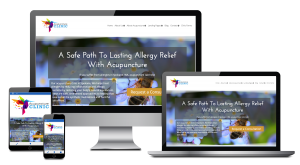 When you’re ready to take your online presence to the next level, AcuPerfectWebsites.com offers everything acupuncturists need to be found, trusted, and booked online — built specifically for practitioners like you.
AcuPerfect Websites and AcuDownloads have partnered to give acupuncturists everything they need to build a strong, authentic online presence without spending hours doing it themselves.
AcuPerfect Websites builds, maintains, and SEO-optimizes your website for you — so new patients can find you, trust you, and book with you. Every site is designed specifically for acupuncturists, with content that reflects the voice and values of your practice.
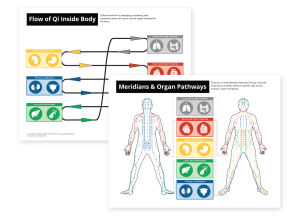 AcuDownloads gives you instant access to a library of 1,300+ professionally written TCM marketing tools — blog posts, newsletters, brochures, social media content, and more. Every piece is created by practitioners who understand your medicine, so you never have to start from scratch.
Together, they solve the two biggest marketing challenges acupuncturists face: having a website that works and having content that keeps it alive.
Start your free trial at AcuPerfectWebsites.com and discover how easy it is to have a complete marketing foundation — a professionally built website and a steady stream of quality TCM content — that truly reflects who you are and the healing power of acupuncture.
AcuDownloads offers acupuncturists professionally written, TCM-rich marketing materials — from newsletters and blog posts to social media content and clinic tools. Everything is designed to help you communicate clearly, build patient trust, and grow your community — while saving you time. Explore the full library at AcuDownloads.com.
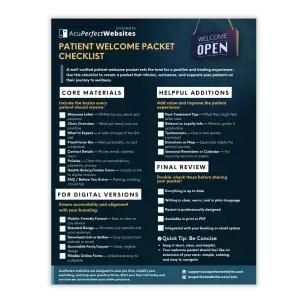 Your first impression can make all the difference in whether a new patient returns. This free Patient Welcome Packet Checklist helps you create or improve your welcome materials so they build trust, set clear expectations, and encourage long-term care. Download it now to make sure your packet supports retention—without missing any important details.
Contact us today if you’re ready to take your website to the next level. At AcuPerfect Websites we can help you establish an online presence that amplifies your new patient efforts.
Get Professional Support
Let us help you grow your practice and become the go-to acupuncturist in your community. Our mission is to help new patients find your practice.
If you want a website that helps attract new patients and supports consistent growth, AcuPerfect Websites can help you build a modern, patient-friendly website that is designed for clarity, trust, and local visibility.
And if you want ready-to-use marketing tools that keep your outreach active even in your busiest months, AcuDownloads gives you a library of acupuncture-focused content you can use right away.
If you are ready to stop relying on spare time to market your practice, take the next step with AcuPerfect websites and build a system that stays active all year.
Get Professional Support
AcuPerfect Websites has been building acupuncture websites since 2011, and we know exactly what works. Our sites are designed with SEO best practices, easy navigation, and conversion-focused layouts—ensuring that your practice ranks well and attracts new patients.
We can help you grow your practice and become the go-to acupuncturist in your community.
Give your practice the refresh it deserves! Let’s get started!